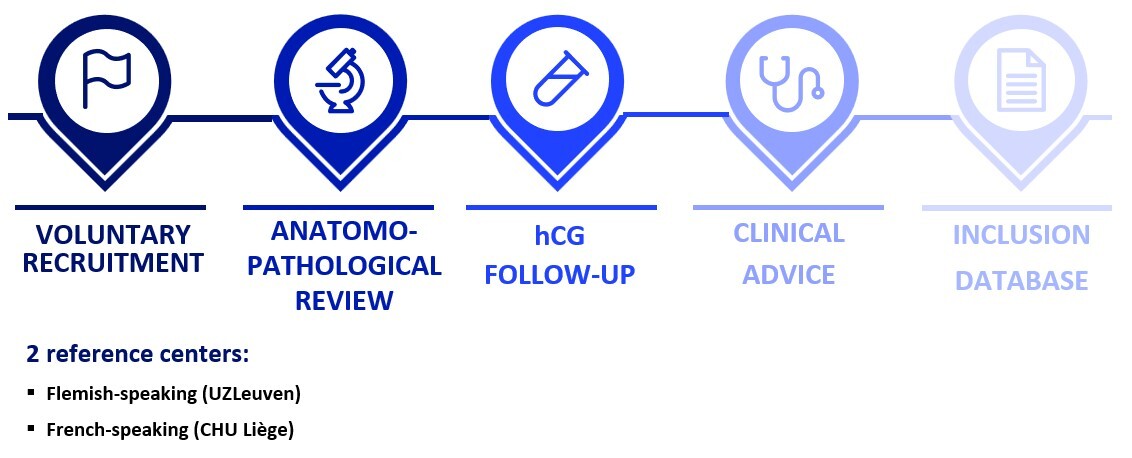
In Belgium, the registration of patients in the registry is done on a voluntary basis.
Reference centers are contacted either by the treating gynecologist, the initial pathologist, or by the patient herself.
On this site, you will find the registration form to be sent to one of the two centers.
In accordance with the General Data Protection Regulation (EU Regulation 2016/679 of the European Parliament and of the Council of 27 April 2016), a signed consent form from the patient is required for registration in the database.
All cases undergo a systematic pathological review. The centers provide therapeutic recommendations adapted according to the latest guidelines. They establish kinetic curves of chorionic gonadotropin hormone (hCG). We communicate information tailored to the types of progression (normalization, stagnation versus rise of hCG levels).
Schoenen S, Delbecque K, Van Rompuy AS et al. Le Registre Belge des Maladies Gestationnelles Trophoblastiques : 10 ans déjà! Gunaïkeia 2022;27:8
Systematic pathological review
When a reference center is asked to provide an opinion on a case, the case undergoes a systematic pathological review by the reference pathologists belonging to an inter-university expert group (ULiège, UCL, ULB, UGent and UZLeuven).
The histological blocks and slides are sent to the expert pathology laboratories, allowing for the review and additional analyses if necessary (immunohistochemistry, karyotype analysis, genotyping).
Diagnoses are made according to the World Health Organization classification (WHO 2020). A prospective multicenter study evaluating the added value of this systematic histopathological review was conducted within the Belgian Registry. The results reveal that 35% of the initial diagnoses are changed following the review.
Clinical advice
The centers collaborate with gynecologists to optimize the monitoring and treatment of these rare and complex pathologies. The goal is to avoid both overtreatment and undertreatment in patients of childbearing age.
On this site, you will find the general guidelines to follow in cases of partial hydatidiform mole, complete hydatidiform mole, or post-molar gestational trophoblastic neoplasia. However, each patient is different, and the experts at the centers are available to offer individualized care plans.